
 Wikicommons
 Timeline
- November 2, 2003 Course of the legislative ballot
- November 3, 2003 Beginning of the contestation
- November 14, 2003 20,000 demonstrators gathered and broadcast by Rustavi calling for civil disobedience
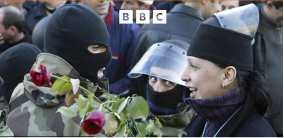
- November 22, 2003 100,000 people gather and peacefully storm parliament with roses, Mikhail Saakashvili leading them.
- November 24, 2003 Shevardnadze's resignation.
- January 4, 2004 Election of Mikhail Saakashvili with 96%.
Key points
The Rose Revolution demonstrates that a regime becomes vulnerable when internal legitimacy is lost, governmental elites fragment, and international support weakens. In Georgia, the electoral fraud of 2003 acted as an accelerator of the latent crisis, leading to open political rupture.
Sustainable mobilisation rests on prior organisational work: structuring of NGOs, activist training, coordination between media, civil society and opposition politics, and anticipation of mobilisation sequences.
Non-violent discipline constitutes a major strategic lever. By reducing the political costs of participation and increasing the costs of repression, it fosters wider social movement expansion and may partially neutralise coercive apparatus.
International support can strengthen civil society capacity without 'manufacturing' a revolution. Western financing, training and logistical support served as organisational accelerators, but relied on deeply-rooted popular discontent.
A unified opposition coalition against a regime does not guarantee consolidated democratic transition. In Georgia, the absence of a shared institutional strategy after victory favoured power concentration around the new executive and progressive weakening of checks and balances.
The Georgian experience shows that a revolution may succeed tactically whilst remaining democratically incomplete. Rapid advances in modernisation and anti-corruption did not prevent the emergence of new power centralisation dynamics, as durable counter-powers failed to develop.
Introduction

In Georgia, in November 2003, political and social tensions crystallised around the concentration of presidential power and the systematic deterioration of democratic practices. In Tbilisi, the forthcoming parliamentary elections were expected to bring about political alternation; for citizens, election observers and human rights activists alike, the issue concerned not only the transparency of the vote, but also the respect for the most basic democratic procedures, which had been imposed without genuine consultation.
The trigger for the political crisis, however, was not the contested regime itself, but rather the sequence of events during the first few days: suspicions of electoral fraud began to circulate, and the publication of the fraudulent results gave the movement an entirely new momentum. International observers and Georgian civil society later summarised this pivotal moment: the confirmed electoral fraud galvanised public mobilisation, and a wave of demonstrations spread throughout the country; the authorities attempted to suppress the movement through threats of coercive intervention, yet in the face of the protesters’ non-violent discipline and growing media coverage, repression proved counterproductive.
This case study offers an analysis of the factors behind the success of the Rose Revolution, notably its ability to transform into a mass movement, unite disparate actors, and impose a significant political cost on the regime. It will examine the mechanisms through which the government of Eduard Shevardnadze was forced into a highly visible crisis-management process marked by a loss of political control and increased international exposure, without, however, leading to a lasting democratic consolidation.
Predispositions for the Movement's Success
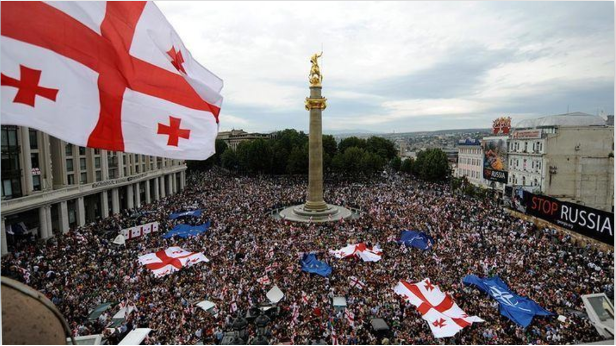
A) An established political crisis before November 2003
Following the dissolution ofthe USSR, Georgia experienced civil war and severe economic instability between1991 and 1993. In 1992, Abkhazia and South Ossetia declared independence. Edouard Shevardnadze was brought to power that same year following a coup d'État. He was elected three years later with 80% of the popular vote, as thepopulation saw in him the man who would stabilise the situation. His presidency marked Georgia's beginning rapprochement with the United States and the European Union, with numerous cooperation agreements testifying to this: TRACECA in 1993, INOGATE in 1996, the "Train and Equip" cooperation agreement with NATO in 2002, and accession to the WTO in 2000.
However, everyday corruptionand poor economic results progressively undermined public trust between governed and governors, weakening the existing regime. Civil society organised in parallel, successfully establishing the Anti-Corruption Coordination Council in 2001. This institution exposed high-level corruption cases. Despite the government's dismissal of some officials, no systematic anti-corruption policy was implemented.
In November 2003, Shevardnadze, still in power and increasingly contested, won parliamentary elections, but his party was suspected of electoral fraud. The electoral rigging, denounced by international observers and Georgian civil society, acted as a crisis accelerator and triggered popular uprisings extending over three weeks. These led to Shevardnadze's regime collapse.
B) A regime weakened internally and externally
Internally, from the early 2000s, Georgian governmental elites fragmented. Several figures progressively embodied opposition to the ruling party. Mikhail Saakashvili, Minister of Justice, denounced governmental class corruption during a ministerial council in 2002 and was forced to resign. He subsequently founded his own party: the National Movement (NM). The United Democrats party (DU) also contested the regime, led by Zhvania. These contestations found echo in local media. The Rustavi 2 television channel played a crucial role in conveying October 2003 events. The mediatisation of contestation shifted the balance of forces, making repression costly should protest movements emerge.
Externally, the regime experienced progressive isolation. Shevardnadze adopted an increasingly ambivalent foreign policy to strengthen legitimacy, notably by relying on Russia. He supported the pro-Russian governor of the autonomous region of Adjaria, eliminated American firms from the national market through arbitrary taxation according to AFP in 2003, sold Tbilisi's electricity distribution company to United Energy Systems (Russian property), and delayed constructing the BTC pipeline, a strategic American investment. Washington officially maintained support for the regime but progressively developed alternative relays within civil society and reformist opposition.
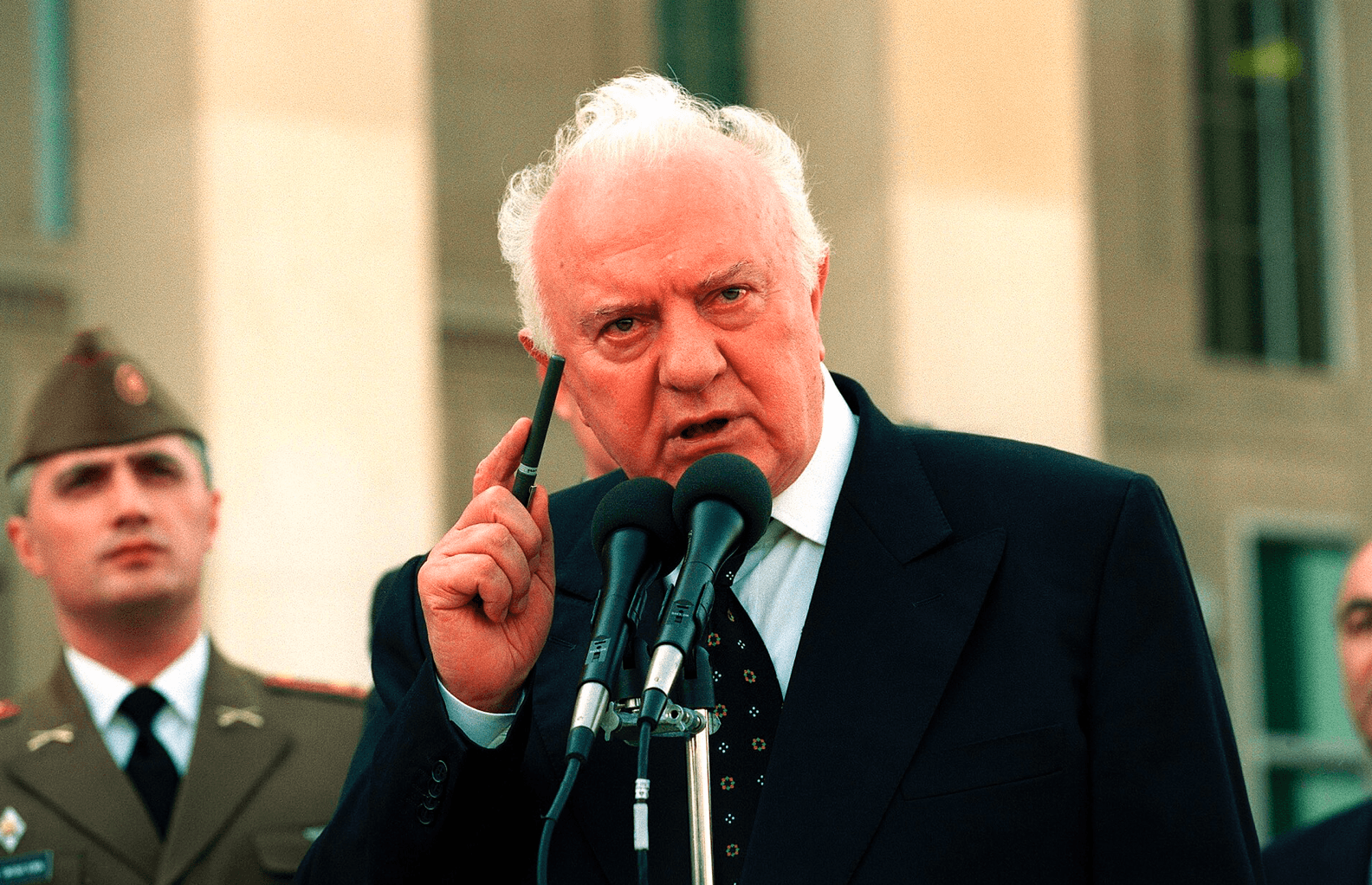
The OSCE was likewise critical of democratisation shortcomings in Georgia. It noted electoral procedure violations as early as 2002 local elections and participated in international monitoring of 2003 elections, reinforcing contestation of the ballot's legitimacy.
Thus, loss of internal legitimacy and external support enabled mobilisation to become politically effective, with concessions becoming more strategic than repression.
Concrete Construction of Mobilisation
A) Mobilisation prepared before the final crisis
The 2003 Rose Revolution wasthe fruit of patient civic work by various local civil society actors, supported by EU and US financing. Under Shevardnadze, Georgia witnessed an "NGO-isation" with multiplying militant associations. Several organisations spearheaded popular mobilisation:
- The Kmara student movement, meaning "enough". It is characteristic of the region's coloured revolutions, modelled on the Serbian Otpor! (same translation). It arose from a 2000 demonstration of 2,500 students in Tbilisi protesting corruption. It developed over time notably through financing from the Open Society Institute, an NGO founded by billionaire Soros. This movement spread across several Georgian towns and was highly active during November 2003 events.
- The Georgia Young Lawyers Association (GYLA), created in 1994, aiming at human rights defence through legal support. It sent 500 observers participating in alternative vote counting.
These associations and NGOs were only part of an organisational tissue employing roughly 1% of the population, conducting civic work across various fields: human rights protection, democratic support and civil society, environmental protection, specific women's issues, support for the displaced, and SME assistance through advice and microfinance.
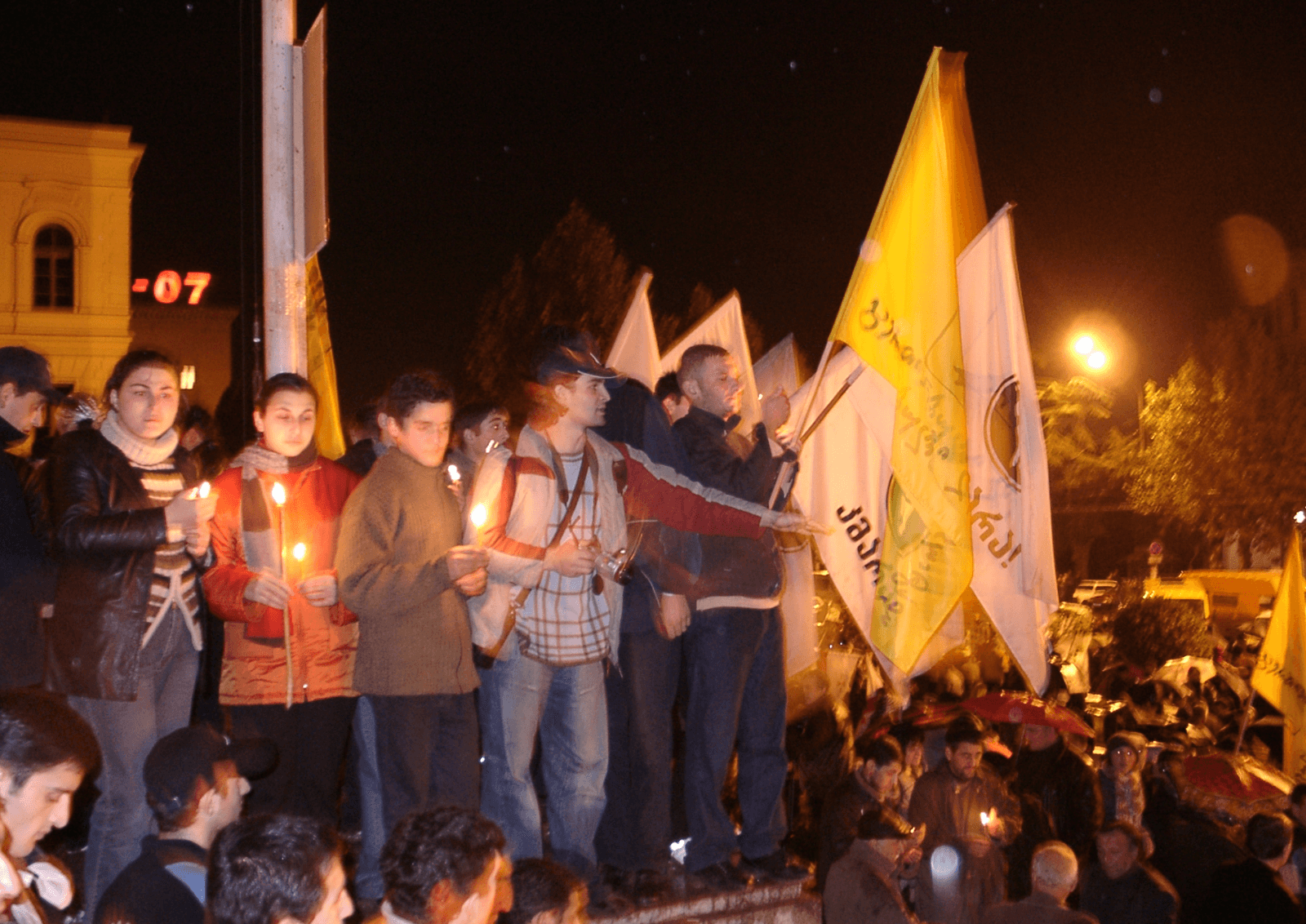
Training in Gene Sharp's non-violent protest techniques before mobilisation was also key to its success. Srdja Popovic (figure of Serbia's Otpor! movement) and Slobodan Djinovic, two non-violent action trainers, came to Georgia to sensitise young activists of the Kmara movement. Peter Ackerman's film "A Dictator" depicting Belgrade's earlier success with Otpor! was widely distributed on anti-Shevardnadze television channels. The Washington Post reported at the time that "thousandsof people had been trained in techniques perfected in Belgrade". Gene Sharp's non-violent action policy was thus known before mobilisation and served as a guiding principle during November 2003 demonstration days.
B) Repertoire of action and sociology of the Rose Revolution
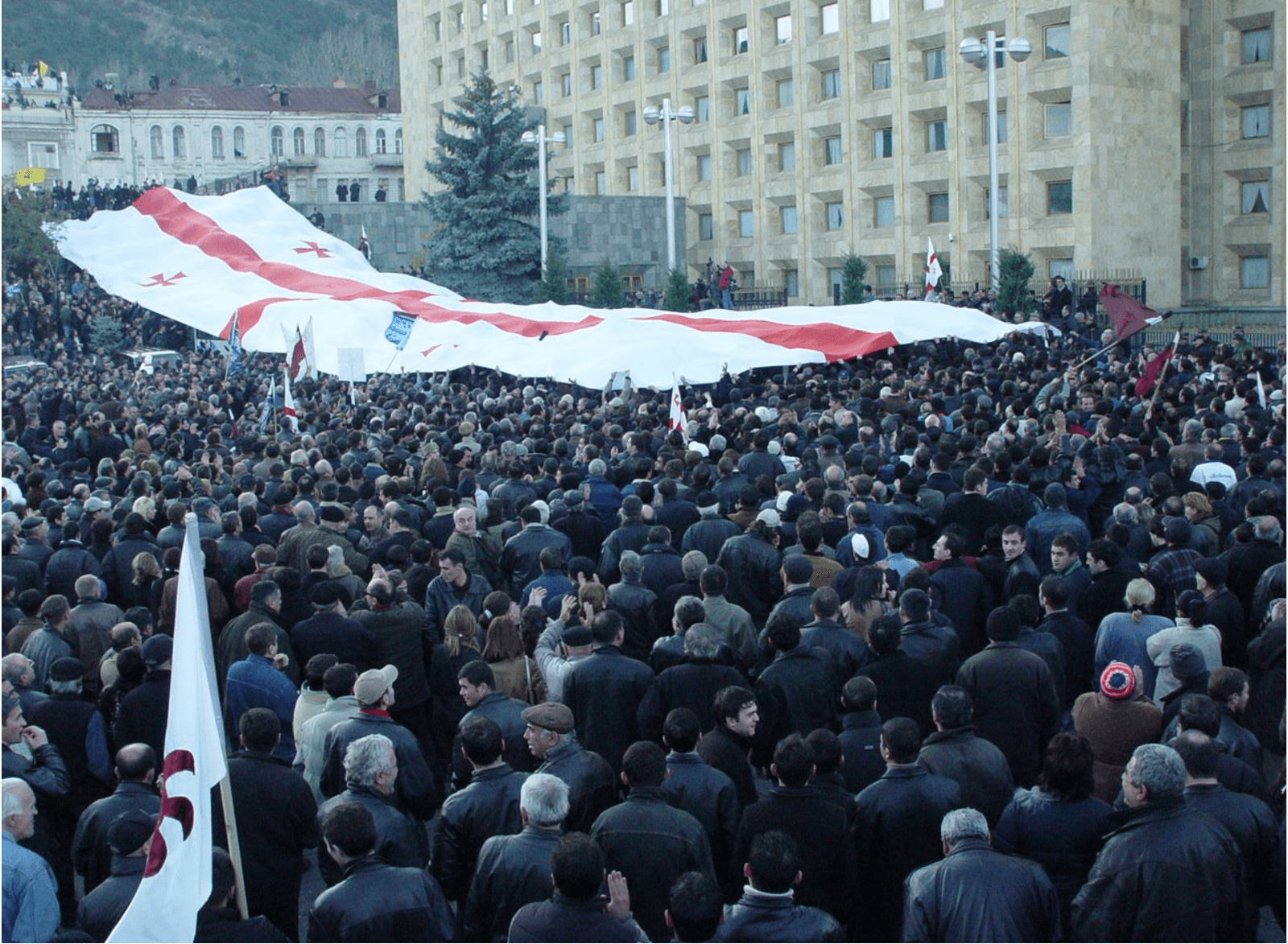
From the day followingelections, electoral fraud suspicions gathered thousands of activists on Tbilisi streets. Initial mobilisation's core comprised Kmara movement students, upper and middle social classes working within NGOs or academia, and opposition parties. Over days, the movement gained momentum. It accelerated sharply when first Adjaria province results were revealed, differing significantly from exit polls organised by activists. On 14 November, 20,000 Georgians marched in the capital. Television channel Rustavi 2 covered events and promoted civil disobedience. The movement then gained progressive support from non-militant populations, sensitised notably through this coverage. On 20 November, official results were published. Two days later, the first parliamentary session was interrupted by the peaceful eruption of activist crowds armed with roses, guided by Mikhail Saakashvili. This symbolic public space occupation by nearly 100,000 Georgians (out of 5 million inhabitants) was relayed by international channels and provoked Shevardnadze's resignation.
C) Internal mobilisation tensions
Opposition forces' unity was not ideological but merely strategic, as Stephen F. Jones emphasises. Anti-Shevardnadze political parties and the NGO tissue associated during mobilisation. In October 2003, a 15-NGO group drafted the document "Enough! 10steps for political freedom". This document was supported by Mikhail Saakashvili's party but no long-term commitment was made. The tactical unity enabling mobilisation's success did not integrate a shared long-term strategic plan.
Dependency on external resources of actors working within civil society formed part of these internal tensions and will be analysed in the next section.
Despite these real tensions, at this section's end, one notes that mobilisation combining militant preparation, social diversification and non-violent discipline increases its overthrowcapacity by reducing governmental power legitimacy.
The role of NGOs and external support: backing or manufacturing?
A) Real external support
External support and NGO roles in mobilisation have been heavily criticised, notably by the government and Russian neighbours, being qualified as American and European interference.
Between 1995 and 2000, USAID (United States Agency for International Development) provided 700 million dollars in financial aid to associations and NGOs promoting democracy and human rights. The EU also offered between 1992 and 2004 aid to Georgia amounting to 420 million euros, financing conditional on democratic progress. The OSCE attested in 2002 to several important rule-of-law advances and detention conditions improvements in Georgia, but also alerted on issues such as human trafficking and electoral irregularities, as previously mentioned.
These financial resources enabled logistical support favouring activist professionalisation. The Kmara movement was financed by the Open Society Institute directed by Madeleine Albright at half a million dollars, allowing it to engage external trainers, send members to Serbia to learn from Otpor!, and establish itself durably in Tbilisi offices.
The International Society for Fair Elections and Democracy, a US-financed NGO, trained Georgian nationals in election organisation and polling, enabling them to credibly contest local 2002 and parliamentary 2003 election transparency shortcomings notably through 2,500 observer deployment.
B) Mobilisation remaining predominantly endogenous
Although external support isreal, mobilisation remains the fruit of local popular discontent. Salomé Zourabichvili, current ex-president, criticises in retrospective interview theforeign interference and destabilisation-tinted reading proposed by some actors. "One must not forget that democracy consists in implementing a system enablingthe Georgian people to make choices" she declares, reminding of the 100,000 mobilised Georgians' deep aspirations on 22 November.
NGOs played in mobilisation anaccelerator and popular anger channelling role rather than that of the Rose Revolution's creator. The local actors number at contestation's heart (Kmara, Lawyers Association, NM, DU, etc.) testifies to strong local mobilisation appropriation capacity despite external resources.
C) Political ambiguities
External financing was nonetheless not entirely disinterested. The USSR's 1991 dissolution left avast, strategically attractive post-Soviet space for the United States. Energy possibilities coupled with a "rollback" strategy of Russian positions made the Caucasus a coveted region. Georgia was one of the theatres of the pipeline warbeing waged by the United States and Russian Federation during this period. Washington financed the Baku-Supsa (Georgia) project, ending Russian hegemony in Caspian hydrocarbon export upon opening in April 1999. The BTC (Baku-Tbilisi-Ceyhan) pipeline's route was also part of this strategy, bypassing Russia, Iran and Armenia.
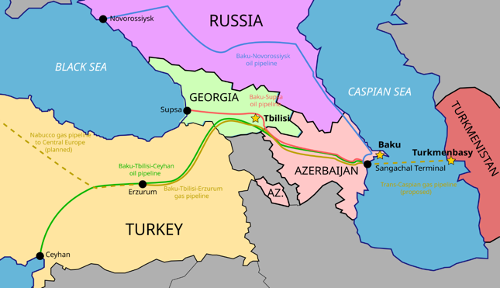
In return, Shevardnadze's regime aligned increasingly with the United States, notably marked in 2000 by dismantling two of four Russian bases in Georgia, or by refusing passage in 1999 to Russian troops for Chechen invasion. American strategic interests in the region are thus significant and partially illuminate the desire to stabilise this energy corridor under construction by working towards democracy and rule of law.
Certain NGO ambiguity regarding transition is also questioned. This applies to the Liberty Institute or the Soros Foundation. Interior Minister Vano Merabichvili, one of the President's principal advisers, Guiga Bokéria, as well as Tbilisi's mayor, Guigui Ougoulava, were former Liberty Institute activists. Education Minister Kakha Lomaïa was former Soros Executive Director. This massive civil society integration into post-mobilisation government questions these institutions'claimed disinterestedness and weakens the associational sector, without nonetheless challenging endogenous aspirations.
Immediate but limited effectiveness

A) What the movement immediately obtains
The day following activists' entry - preceded by Mikhail Saakashvili - into parliament, Shevardnadze resigned from the presidency and the fraudulent ballot was annulled. Nino Bourdjanadze, Parliament President, assured de facto interim presidency pending new democratic elections. From Sunday 4 January 2004, Mikhail Saakashvili won organised elections with 96% of votes. Mobilisation enabled genuine rapid political alternation.
Upon taking power, Mikhail Saakashvili initiated reforms responding to Georgian transparency and economic aspirations. From 2004, he liberalised the market and favoured private sector development. He also implemented strict anti-corruption policy. According to Transparency International rankings, Georgia moved from 133rd place globally for corruption in 2004 to 67th in 2008. He ended electricity cuts contributing to popular discontent and improved road conditions.
The new government claimed foreign policy directed towards Europe and NATO. The Ministry for European and Euro-Atlantic Integration was created accordingly.
B) What the movement does not sustainably transform
The new regime formed around President Mikhail Saakashvili. Integrating the contentious political class and part of civil society severely limited checks and balances creation. Television channel Rustavi 2, long a key counter-power, adopted government-friendly discourse and even temporarily took the slogan "channel of those who won". Salomé Zourabichvili deplores the judicial system's state and denouncesopposition television absence.
In 2007, anti-governmental demonstrations were repressed and a state of emergency was decreed for oneweek, censoring all country media. The 2008 invasion of breakaway provinces Abkhazia and South Ossetia decreed by Mikhail Saakashvili resulted in humiliating defeat against Russia and declining regime confidence.
The dissonance between immediate results and long-term changes evidences tactical success but democratic strategy failure.
Operational lessons
A) What makes mobilisation effective
The local NGO tissue possessedshared understanding of reform needs and conducted well-coordinatedorganisational preparation. They notably employed period communication means: emails and fixed phones by developing shared narrative, enabling broad awareness. Strategic alliance with opposition parties enabled greater contestation movement scope.
The Rose Revolution's non-violent discipline strengthened coordination image and militants' sharedwill.
Activists were sensitised to non-violent methods and notably to fraternisation with law enforcement. November's daily mobilisations experienced very rare incidents, with media coverage increasing repression cost. Shevardnadze ordered forces to organise repression the day after his flight. But peaceful event progression led police to heed the interim president's orders. The army remained neutral during the Rose Revolution.
Coalition social diversity strengthened movement claim legitimacy.
B) What weakens post-victory
One of the Rose Revolution's principal lessons resides in the absence of shared institutional strategy oncethe regime was overthrown. The mobilisation-enabling coalition rested primarily on a shared negative objective: ending Shevardnadze's rule. Conversely, durable democratic system construction modalities had not been the subject of structured agreement between movement components. This shared institutional projection absence favoured rapid power concentration around President Mikhail Saakashvili and his entourage.
Leadership personalisation enabled strong immediate post-revolution decision-making capacity, notably in anti-corruption struggle and administrative modernisation. However, progressive power centralisation limited autonomous checks and balances development. Part of civil society and media participating in contestation integrated into the new state apparatus or adopted more government-favourable positions, reducing their critical capacity.
This dynamic strengthened over years through increasingly vertical and security-focused political strategy. 2007 demonstration repression then 2008 Russian-Georgian conflict management contributed to democratic power legitimacy fragility. The desire to rapidly restore state authority and reaffirm Georgian territorial sovereignty progressively took precedence over pluralistic political system consolidation.
The Georgian experience thus shows that effective mobilisation against contested regime does not automatically produce consolidated democracy. Without solid power limitation mechanisms, media pluralism and institutional independence, a revolution's tactical success may result in power reconfiguration rather than durable democratic transformation.
C) Contemporary Georgian actuality
The Rose Revolution continues to exert important influence on contemporary Georgian political life. The 2024 mobilisations against the "foreign influence" law testify to persistent fractures opened in 2003 around the democratic question, NGO role and the country's European orientation. Demonstrations revealed persisting civil society capacity for substantial mobilisation, notably amongst young urban generations.
This law contestation also illustrates structural tension permanence: part of the Georgian associational tissue's dependency on Western financing continues to be used politically by authorities and Russia to delegitimise pro-democratic actors by presenting themas foreign interest relays. This rhetoric inscribes itself in direct continuity with Rose Revolution-era criticism.
Moreover, the European question remains central in Georgian political debate structuring. Popular support for European integration remains high despite political alternations and internal tensions. The European Union thus retains both geopolitical and symbolic function in contemporary mobilisations.
Finally, the Georgian case reminds us that fragmented opposition encounters difficulties transforming popular mobilisation into durable political change. As in 2003, capacity to maintain unified coalition around clear strategic objectives appears determinant. The Rose Revolution experience nonetheless emphasises that contestation phase effective coordination must also accompany thorough reflection on post-victory institutional organisation to avoid reproducing new power concentrations.
""One must not forget that democracy consists in implementing a system enablingthe Georgian people to make choices""
Operational lessons
The vitality of civil society
The network of local NGOs shared a common understanding of the need for reform and undertook well-coordinated organisational preparation. In particular, they made use of the communication tools available at the time (emails and landline telephones) while developing a shared narrative, which enabled broad public awareness and mobilisation. A strategic alliance with opposition parties further amplified the protest movement.
Non-violent dynamics
The non-violent discipline of the Rose Revolution strengthened the image of coordination and shared purpose among activists. Activists had been trained in non-violent methods, notably the practice of fraternising with law enforcement. The daily mobilisations of November saw only very rare instances of disorder, and media coverage increased the cost of repression. The day after his flight, Shevardnadze ordered the security forces to organise a crackdown. However, the peaceful unfolding of events led the police to fall in line with the orders of the acting president. The army remained neutral throughout the Rose Revolution.
Planning for the aftermath
One of the key lessons of the Rose Revolution lies in the absence of a consensual institutional strategy once the regime had been overthrown. The coalition that had enabled the mobilisation rested above all on a shared negative objective: to bring Shevardnadze's rule to an end. By contrast, the modalities of building a lasting democratic system had not been the subject of any structured agreement amongst the various components of the movement. This absence of a shared institutional vision facilitated a rapid concentration of power around President Mikheil Saakashvili and his inner circle.
The Personalisation of Power
The personalisation of leadership enabled strong decision-making capacity in the immediate post-revolutionary period, particularly in the fight against corruption and administrative modernisation. However, this progressive centralisation of power constrained the development of autonomous checks and balances. A portion of the civil society organisations and media outlets that had taken part in the contestation were absorbed into the new state apparatus or adopted a more favourable stance towards the government, thereby reducing their critical capacity.
1. MathisPuyo – The coloured revolutions in post-USSR: Georgia, Les Yeux du Monde (2022)
2. DavidAprasidze – Civil society and anti-corruption reform in Georgia: returning tothe Rose Revolution (2025)
3. OSCE– Annual report of OSCE activities in 2002
4. MarcieSmith – Change Agent: Gene Sharp’s Neoliberal Non-violence
5. JoshuaA. Tucker – Enough! Electoral fraud, collective action problems andpost-communist coloured revolutions
6. Hérodote– Interview with Salomé Zourabichvili, The Rose Revolution at an impassep.101-108
7. SilviaSerrano – Post-Soviet Georgia: lost in transition? p.67-90
8. StephenF. Jones – The Rose Revolution: A Revolution without Revolutionaries? (2006)
9. SilviaSerrano – Political stakes of the revolutionary reference in Georgia (2008)
10. TransparencyInternational – Rankings from 2004 and 2008
Support Fondemos
Every donation helps us continue producing independent analysis.