
Today marks five years since Myanmar’s military seized power on 1st February 2021. The country remains trapped in a widening civil war and a deepening humanitarian crisis. Looking back over the past five years shows how a coup rapidly escalated into a nationwide conflict. In 2021, the coup triggered the ” Spring Revolution ”: mass, peaceful protests and a nationwide Civil Disobedience Movement (CDM) demanding a return to civilian rule. The crackdown was immediate and lethal. By mid-2022, monitors reported that more than 2,000 civilians had been killed. In April 2021, anti-coup lawmakers and allies announced the creation of the National Unity Government (NUG), seeking to unify the anti-junta front. Around it, armed resistance expanded through the People’s Defence Forces (PDFs), alongside growing coordination with Ethnic Resistance Organisations (EROs). By 2022, the resistance was consolidating across fragmented fronts. Opposition actors strengthened links across regions and ethnic lines, often difficult in practice, shifting from spontaneous mobilisation to more structured political and operational coordination. The junta retained control of key cities and major corridors, but its grip eroded elsewhere. The conflict reached an operational turning point in 2023. On 27 October, Operation 1027, launched by the Three Brotherhood Alliance (the Arakan Army, Ta’ang National Liberation Army and Myanmar National Democratic Alliance Army), marked a major escalation. The coordinated offensive achieved significant gains and exposed the junta’s vulnerabilities, with ripple effects on regional dynamics, including China’s posture along border areas where its interests were directly at stake. In 2024, the regime’s strains became harder to hide. In February, the junta-imposed conscription was widely interpreted as a sign of manpower stress and a catalyst for panic and departures, especially among young people. From May onward, the resistance launched a renewed offensive (1027-2), while the junta leaned even more heavily on air power and indiscriminate violence, including frequent bombardments of civilian areas and the increasing use of drones. In 2025, the crisis was shaped by disaster and renewed political manoeuvring. The 28 March earthquake near Mandalay compounded an already catastrophic situation, with fatality estimates around 5,500. But it didn’t stop the junta from bombing civilians and attempting to block humanitarian aid. As the conflict continued, the junta sought to project stability by reviving the prospect of general elections, formally launching the process on 28 December. Framed as a pathway to ” normalisation ”, the vote appeared primarily aimed at securing domestic and international legitimisation. The opposition, and large part of the international community, including ASEAN, rejected the process outright, continuing to pair political mobilisation with military pressure. Despite the appearance of stalemate, the NUG and EROs continue to pursue a democratic outcome. Recent coordination efforts include the formation of the Spring Revolution Alliance (SRA), which brings together more than 19 opposition groups. Meanwhile, the humanitarian situation continues to deteriorate. The UN’s 2026 Humanitarian Needs and Response Plan (HNRP) estimates that 16.2 million (It notes that this figure is based on the plan’s defined scope of affected areas, rather than the country’s entire population, in 2025 UN HNRP estimated the number of people in need at 19.9 million nationwide.) people will require humanitarian assistance and that more than 3.5 million are displaced. What is needed now is not only a firm rejection of these sham elections, but also a stronger and more coordinated stance from both Western governments and ASEAN member states. European and American sanctions are a first step, yet they are not enough on their own to end the war or protect civilians trapped in an escalating humanitarian catastrophe. The fifth anniversary of the coup should not be treated as symbolic, it should instead be a moment to intensify pressure and support, as opposition forces organise and wait for meaningful international backing.
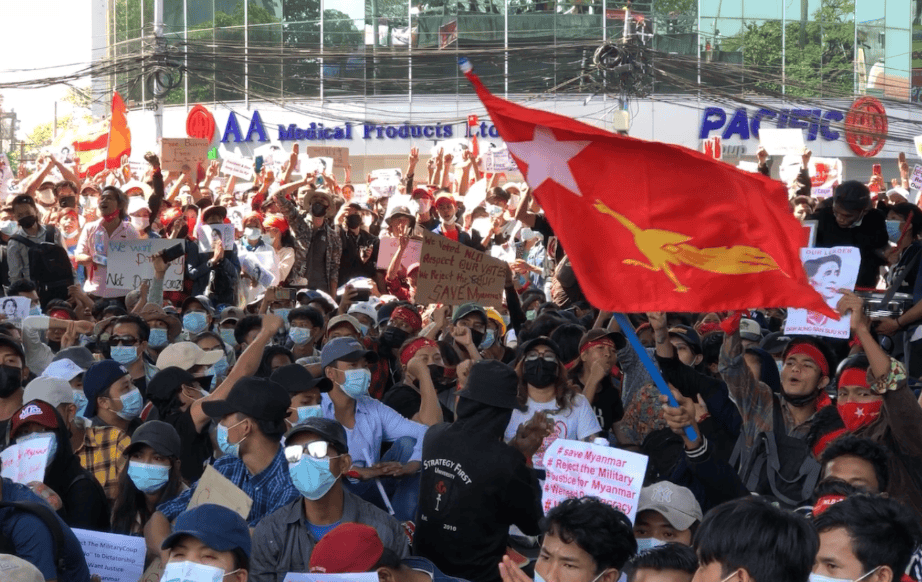
Today marks five years since Myanmar's military seized power on 1st February 2021. The country remains trapped in a widening civil war and a deepening humanitarian crisis. Looking back over the past five years shows how a coup rapidly escalated into a nationwide conflict.
Key takeaways
- Operation 1027 in October 2023 marked a military turning point, exposing junta vulnerabilities and reshaping China's posture along border areas.
- The UN's 2026 HNRP estimates 16.2 million people need humanitarian assistance and more than 3.5 million are displaced in Myanmar.
- The fifth anniversary of the coup should prompt intensified pressure and support, not be treated as symbolic.
Support Fondemos
Every donation helps us continue supporting democracy's defenders.