
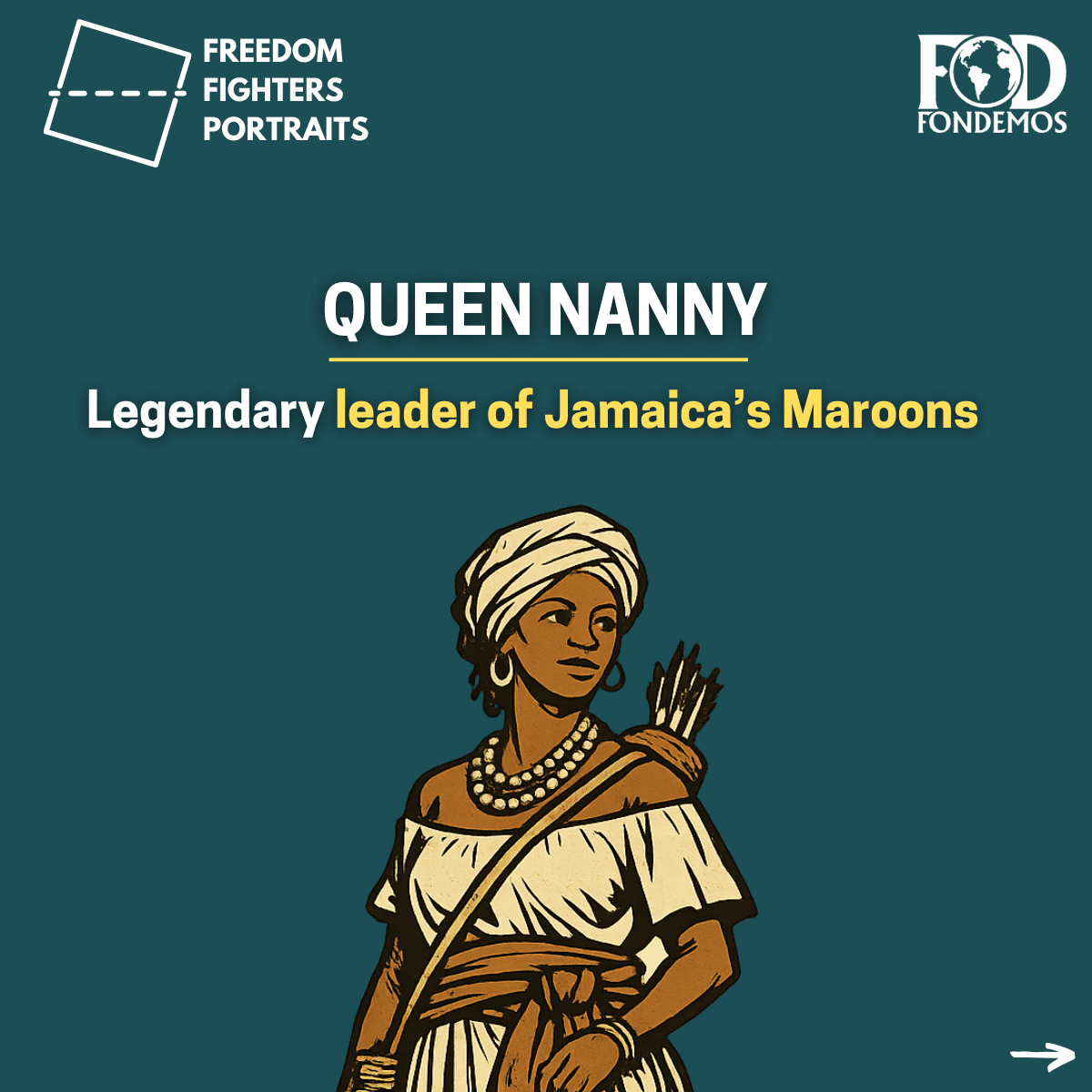
Key points
- 01 Around 1686, Nanny escaped enslavement in Jamaica and joined the Windward Maroons in the Blue Mountains, helping to build Nanny Town, a fortified community and base of resistance against colonial rule.
- 02 During the First Maroon War (1728-1740), she led guerrilla campaigns against British forces, using mountainous terrain, ambush tactics, and the abeng horn to sustain and coordinate her community's resistance.
- 03 In 1740, a treaty formally recognised Windward Maroon autonomy, granting 500 acres in Portland. In 1975, Jamaica declared Nanny a National Hero, and her portrait appears on the 500-dollar banknote.
The emergence of Nanny Town
Around 1686, Nanny lands in Jamaica aboard a slave ship from West Africa. She escapes the slave system and heads to the eastern part of the island, into the Blue Mountains. There, she joins the Windward Maroons, one of Jamaica's Maroon groups. Maroons were communities of escaped enslaved people organised into free, defensive societies. The Windward had already been settled in these highlands since the 1600s, fleeing the plantations. Nanny then helps to build their lasting autonomy in Portland Parish. From this organisation emerges Nanny Town, a fortified refuge that became a base of resistance.
Organising to resist
In the early 1720s-1730s, the British sought to reassert control over the island's interior and reduce the Maroons' autonomous space. Facing a better-equipped force, Nanny turns the mountains into a strategic advantage and leads a form of guerrilla warfare based on mobility and surprise. The Maroons move under forest cover, set ambushes, then withdraw along paths known only to them. The abeng, an animal horn, serves as a long-distance signal to warn, rally and coordinate, and this collective discipline sustains the community.
Towards the 1740 treaty
Between 1728 and 1740, the First Maroon War pits the Maroons against the colonial forces, and Nanny embodies the steadfastness of the Windward groups in the east. In 1734, Nanny Town is taken and then abandoned, but the resistance survives: groups disperse, regroup, and continue to shelter people on the run. As British campaigns bogged down, negotiation became the only lasting way forward. In 1740, a treaty recognises the autonomy of the Windward Maroons and grants them 500 acres, more than 200 hectares, in Portland, formalising what the struggle had already imposed.
Nanny's enduring legend
After the 1740s, her name remains tied to Portland's communities, and to New Nanny Town, later known as Moore Town, and lives on in collective memory. In 1975, Jamaica proclaims her a National Hero, and she becomes an official figure of resistance and self-determination. Her portrait on the 500-dollar banknote carries the message forward each day: a freedom won and defended by a woman of war and of unity.
« All the legends and documents refer to Nanny of the First Maroon War as the most outstanding of them all. »
Support Fondemos
Every donation helps us continue supporting democracy's defenders.