
Key points
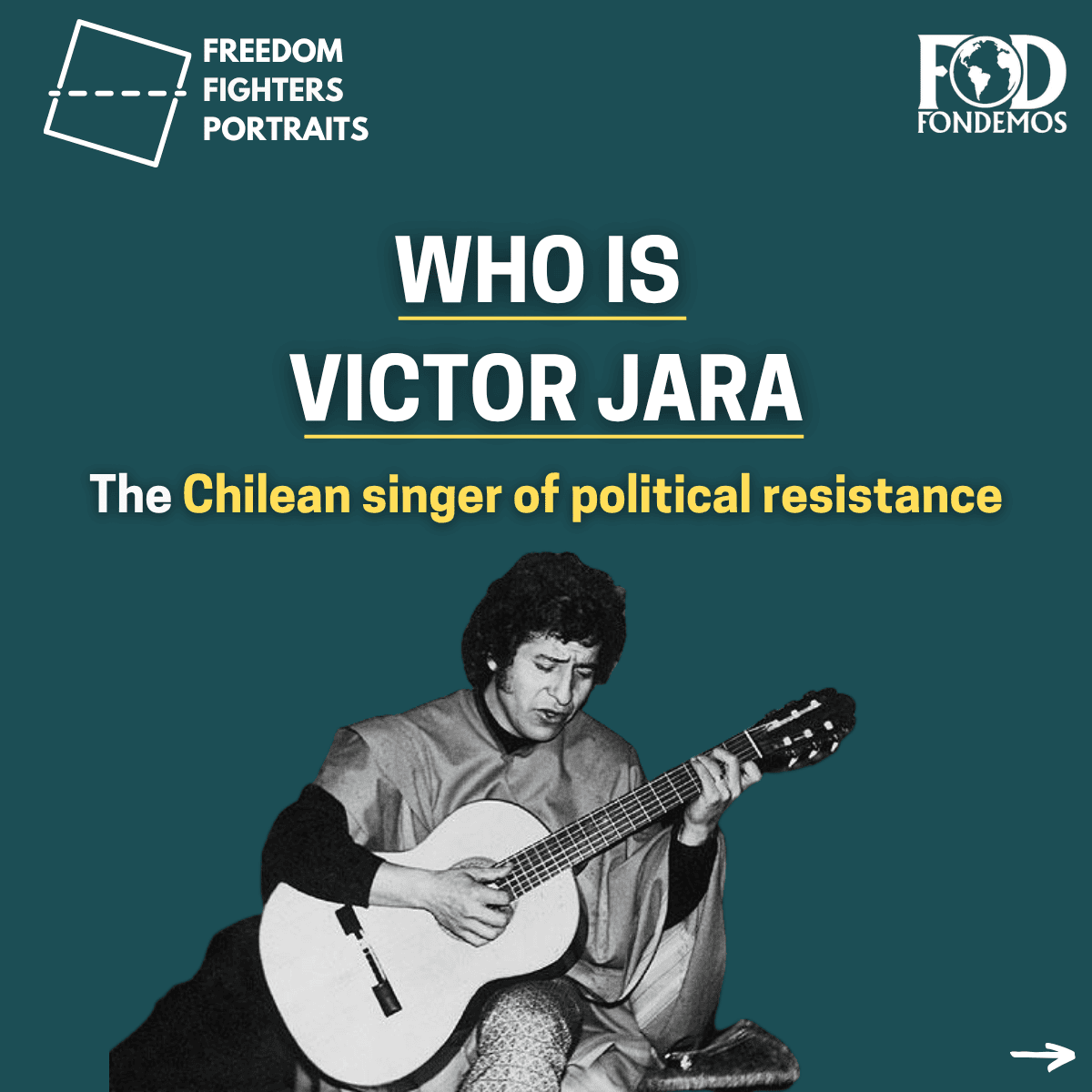
- 01 Victor Jara was a Chilean singer-songwriter and key figure of the Nueva Canción movement, using music to support Salvador Allende's government and left-wing political causes in the early 1970s.
- 02 After Pinochet's coup on 11 September 1973, Jara was arrested, tortured, and executed, becoming a symbol of the regime's systematic targeting of artists and activists.
- 03 In 2018, a Chilean court convicted former soldiers for his murder, providing formal legal recognition of the crime more than four decades after his death.
From reform to dictatorship
1960s–70s Chile was shaped by stark inequality and political polarisation. In 1970, Salvador Allende became the first Marxist elected democratically in Latin America. His project faced internal opposition and external pressure, notably from the United States. On 11 September 1973, Augusto Pinochet led a military coup, replacing democracy with a brutal dictatorship.
An artist shaped by rural Chile
Born in 1932 to a peasant family, Víctor Jara was deeply influenced by rural culture and his mother's folk singing. After early work in theatre, he became a singer-songwriter whose art combined music, poetry and political commitment. He used music and theatre to support left-wing movements and political education.
Nueva Canción activism
Jara was a leading figure of the "Nueva Canción Chilena", a movement blending traditional Andean music with political lyrics, alongside artists like Violeta Parra. Songs such as "Plegaria a un Labrador" were widely performed in factories, universities and pro-Allende events in the early 1970s, making it recognisable anthems of Chile's popular unity movement.
Arrest and execution
After the 1973 coup, Jara was arrested at the University of Chile and taken to the Santiago stadium, where thousands were detained. He was tortured and executed days later. His murder symbolised the systematic targeting of artists and activists. On July 3, 2018, the Chilean courts recognised the crime and convicted former soldiers for his murder.
Legacy through music
His song "Te Recuerdo Amanda" exemplifies his ability to convey social struggle through intimate, human narratives. Through a simple love story between factory workers, Amanda and Manuel, separated by factory work and cut short by Manuel's death, Jara highlights exploitation and structural inequality. He is then ensuring their experiences remain embedded in Chile's collective memory.
« The right to live in peace is a universal song, a force that will ensure the right to live in peace prevails. »
Support Fondemos
Every donation helps us continue supporting democracy's defenders.