
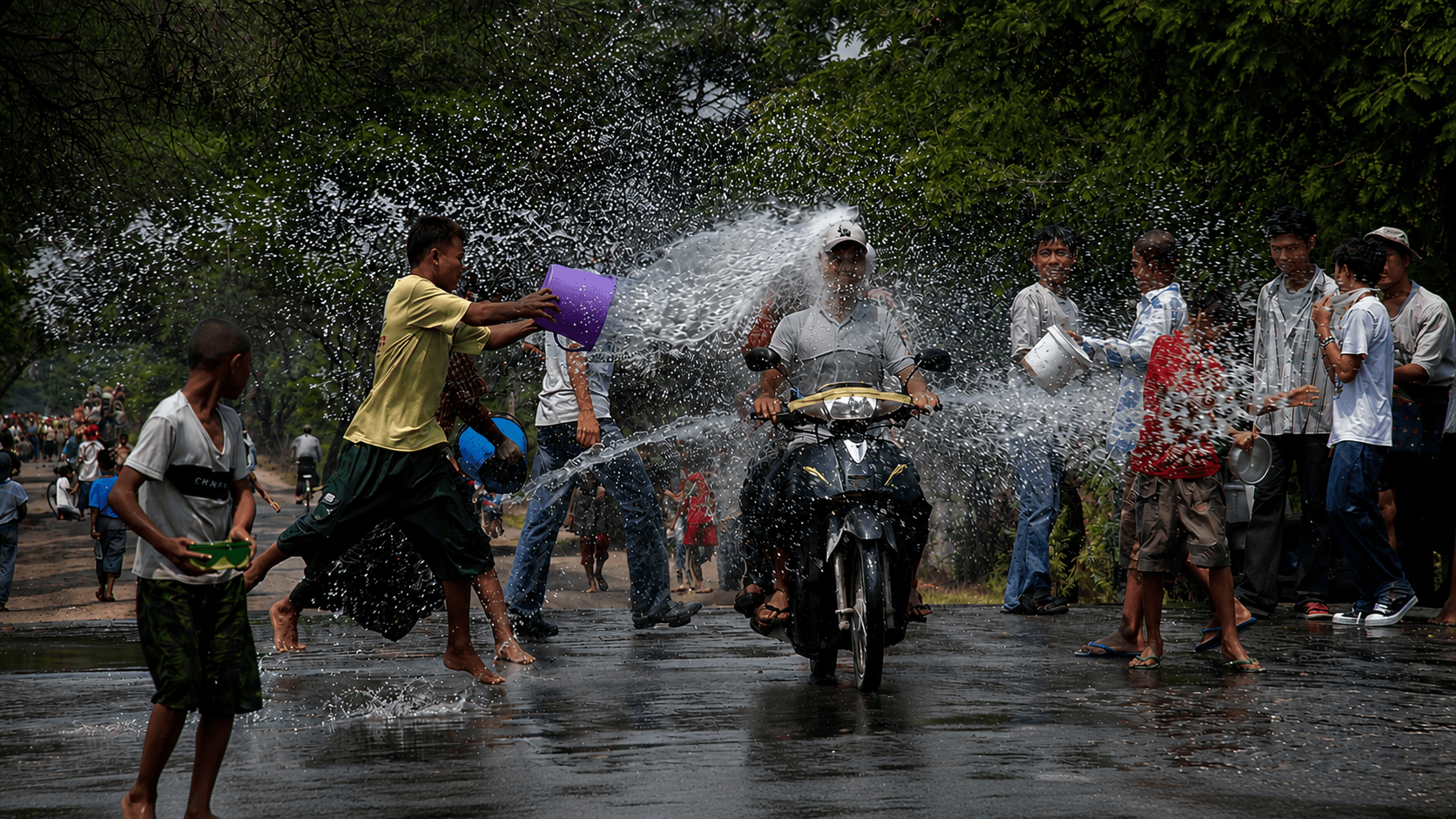
Yangon, April 2026. The city is in festive mood for Thingyan, the Buddhist New Year. The crowd is armed with water pistols, and anyone venturing outside will end up soaked. Even the security forces take part, breaking a taboo for a week. Here, there is little discussion of what is happening in the political capital, the junta’s stronghold, in Naypyidaw. Young people celebrate, drink, and talk about family and love, but rarely about politics. What is the point of speaking of misfortune? In day-to-day life, negative encounters with the military are rare; their discreet presence is most visible in the fortified outposts scattered across the city. But what may at first appear to be indifference conceals a profound despair about the current situation: young adults grew up during the open period under Aung San Suu Kyi, when freedom of expression and a democratic spirit coexisted with an unprecedented opening of the country and an economic boom. The 2021 coup deprived them of that freedom. Everyone speaks of friends who have been imprisoned and tortured, killed, or who have joined various resistance groups.
A dictatorship dressed in civilian clothes
Following manipulated elections, junta chief Min Aung Hlaing was appointed President on 10 April by a parliament of loyalists. Aung San Suu Kyi’s great adversary appears to have succeeded in his gamble: consolidating his grip on the country through the military, then engineering a transition towards an appearance of civilian governance. The revolutionary hope that still prevailed in the city in the aftermath of the February 2021 coup appears to have vanished, replaced by a melancholic resignation. Those who rose up at the time are in prison, in the jungle, or have been forced into compliance. The major cities (Yangon, Mandalay, Naypyidaw), dominated by the SAC, the State Administration Council, are quiet today.
Life in the countryside, where many villages remain outside the junta’s exclusive control, is very different.
A woman from Chin State tells us about her village, which was completely razed by the military following clashes with local PDFs (People’s Defence Forces, resistance militias linked to the NUG, the parallel government). A restaurant owner shows us photos of his home in a village an hour from Yangon, struck by indiscriminate junta bombardments. In another village two hours from Mandalay, the authorities had banned gatherings, then bombed a football match, killing and injuring several people.
Such accounts, direct or indirect, are frequent, so frequent that they have become almost banal. Everyone seems to have a story to tell about the junta’s brutality.
Some speak of a profound sense of guilt at living a privileged life in the major cities, celebrating and finding distraction, while their friends are in prison or dead and their fellow citizens living in villages endure often indiscriminate violence from the junta. Many covertly finance opposition groups.
The personal cost of resistance
Ma Kyaw (all names have been changed) works for an NGO. She suffers from anxiety disorders; the coup, combined with the Covid-19 period, dealt a severe blow to her mental health. She had to uninstall Facebook (theoretically blocked but accessible via VPN, where information circulates more freely) because news of the atrocities being committed triggered anxiety attacks.
The coup also saw the European funders of her former project suddenly withdraw, marking an abrupt end to a five-year development project. She falls into depression over this work and these years “wasted”. She too has financed the opposition, but has always refused to fund weapons and ammunition, unwilling to contribute directly to the armed struggle.
Ko Kun, a lawyer, faces a similar situation. He refuses to leave the country, preferring to support the opposition from within. He belongs to that generation of active adults who lived through the period of openness, and who are secretly fighting back by financing various opposition groups. He too suffers from a deteriorating mental state, and takes refuge in his work to escape thoughts of the horrors the junta is committing.
Supporting the opposition carries real risks. Ma Yamin was secretly supporting local PDFs, and was denounced by her ex-husband following their divorce. She narrowly escaped prison by fleeing the country within an afternoon, and now lives in forced exile.
Instruments of civilian repression
The regime has imprisoned more than 30,500 opponents for political reasons since the coup, of whom nearly 23,000 remain in detention.
Those who took part in the Civil Disobedience Movement (CDM) remain in the army’s crosshairs today. They are formally banned from leaving the country, and their movements within it are restricted and subject to prior authorisation. The professions they may practise are limited. Thaw Su took part in the CDM movement and remains on the junta’s blacklist today, required to seek authorisation from the authorities for any travel outside Yangon. The appeals process that is theoretically supposed to allow removal from this list has made no progress in years. Phone Myo, a young educator, was refused permission to travel to Bangkok for medical treatment, a routine journey in a country where healthcare does not meet the need.
Another lever used by the junta: the conscription law activated in 2024 has served to bolster army ranks. Young men aged 18 to 35 and young women aged 18 to 27 are drawn by lot to serve for at least two years. This has intensified the flight of young talent to other countries, particularly Thailand. Among them is young Ko Myo, employed at a think tank in Chiang Mai, who can no longer return to visit his family without risking forcible enlistment in the Tatmadaw.
If Thingyan’s water pistols offer the illusion of carefree abandon, they cannot wash away the trauma of a nation, nor extinguish the embers of a contestation that has simply changed its form.
Far from the mass demonstrations of 2021, the Burmese resistance has transformed into a war of attrition. Whether covertly financing movements operating in the shadows, fleeing forced enlistment at the risk of one’s life, or simply surviving daily anguish, the youth prove that the veneer of civilian governance will not be enough to erase the memory of blood spilled.