
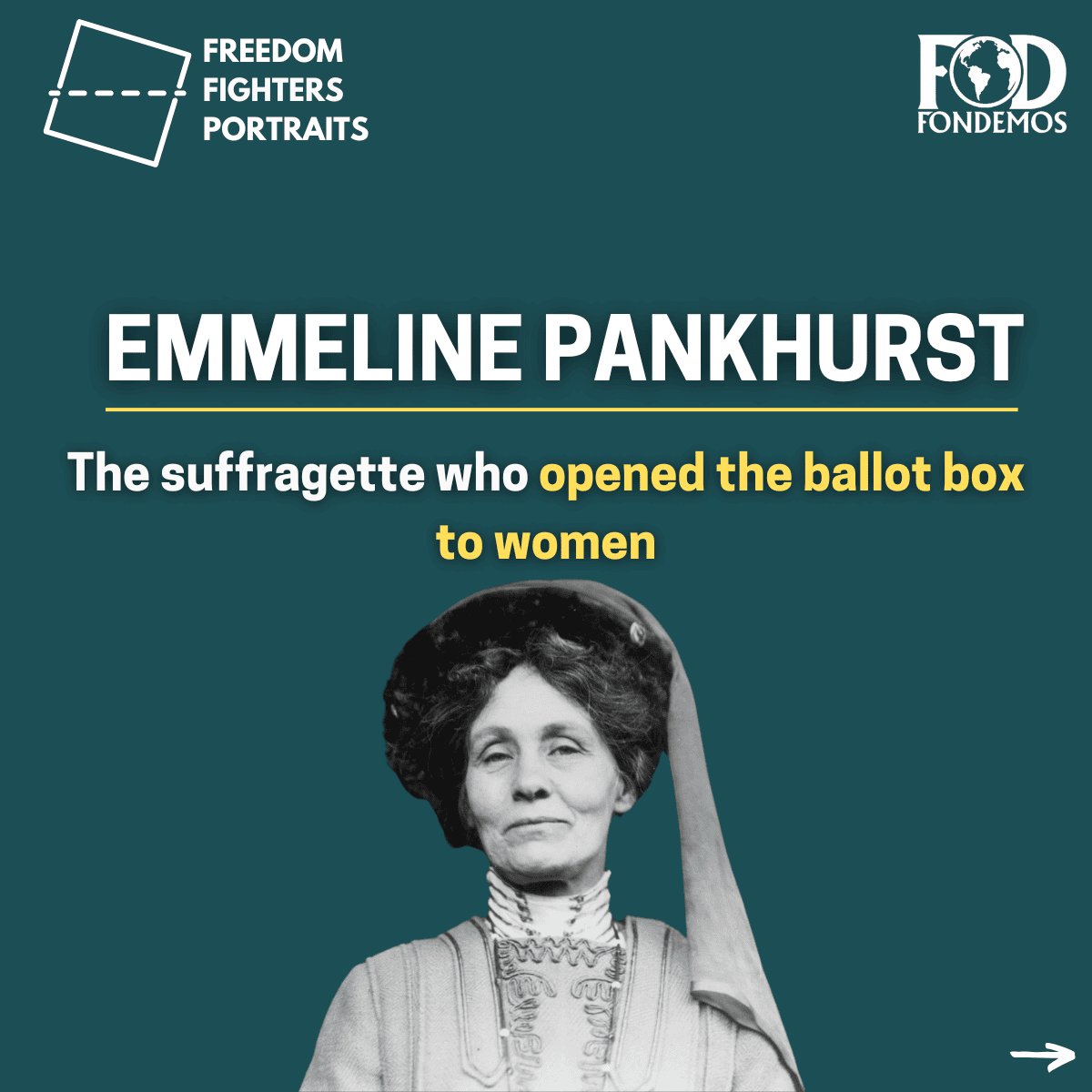
Key points
- 01 In 1903, Emmeline Pankhurst founded the Women's Social and Political Union, adopting direct action, civil disobedience, and hunger strikes to demand votes for women in Britain.
- 02 On 18 November 1910, known as Black Friday, she led a suffragette march to Parliament that was violently repressed by police, drawing national attention to the cause.
- 03 In 1928, the Equal Franchise Act gave all British women over 21 the right to vote, the same year Emmeline Pankhurst died, crowning a lifetime of militant activism.
A political childhood
Emmeline was born in Manchester in a household where democracy and social justice are constantly discussed. Her mother is taking her at a very young age to meetings on women's suffrage, where she realises that citizenship could not remain a men-only affair. In 1878, she marries Richard Pankhurst, a progressive lawyer who supports votes for women. Together, they become involved in the _Women's Franchise League_ , which campaigns for women's right to vote as well as equality in marriage, divorce and inheritance.
"_Deeds, not words_"
In 1903, she founds the Women's Social and Political Union (WSPU). Its slogan, " _Deeds, not words_ ", is radical: the WSPU demands effective female suffrage and makes direct action a legitimate means of forcing democracy to live up to its promises. In 1906, _Daily Mail_ journalist Charles Hands refers to the feminist activists with the nickname " _suffragettes_ " to mock them. Emmeline and her allies adopt the term, using it to distinguish themselves from more moderate groups.
Confrontation with the state
Under her leadership, the suffragettes organise demonstrations, disrupt meetings and carry out acts of civil disobedience. When arrested, they are imprisoned, resort to hunger strikes and suffer forced feeding: their bodies become a battleground for political protest. On 18 November 1910, during " _Black Friday_ ", the demonstration led by Emmeline to Parliament is violently repressed by the police.
War and the right to vote
In 1914, Emmeline suspends the activities of the WSPU and calls on women to take part in the war effort. In 1918, an initial act grants the right to vote to certain British women. In 1928, the _Equal Franchise Act_ extends it to all women over the age of 21, in the very year of Emmeline Pankhurst's death. A central figure, often on the front line, she is a decisive activist in winning the right to vote for British women.
« Women had always fought for men, and for their children. Now they were ready to fight for their own human rights. »
Support Fondemos
Every donation helps us continue supporting democracy's defenders.