
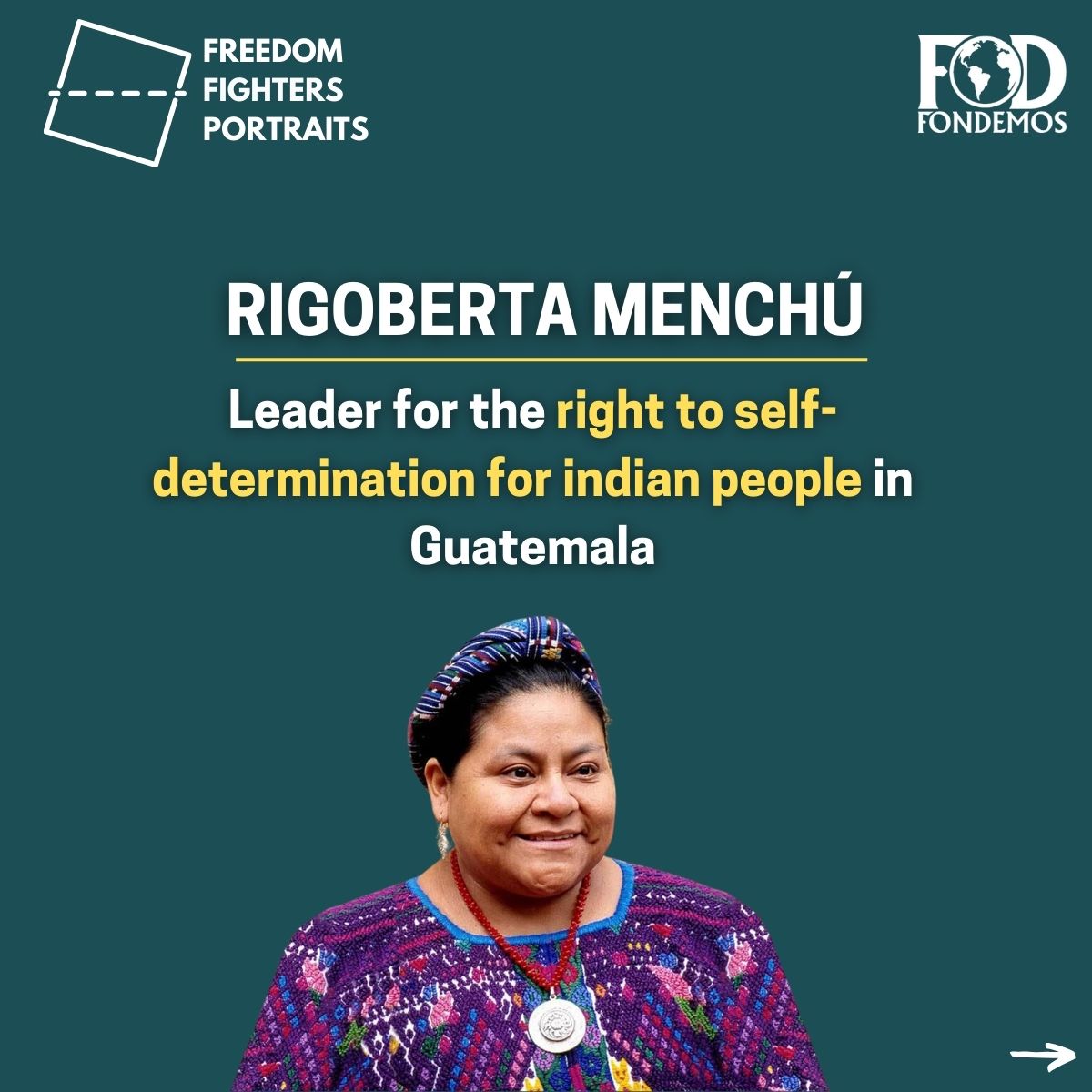
Key points
- 01 Rigoberta Menchú, born in 1959 into the Quiché Maya community in Guatemala, became a leading activist for indigenous land rights and joined the Peasant Unity Committee (C.U.C.).
- 02 Forced into exile in Mexico in 1981 after her parents and brother were killed by the military regime, she continued her peaceful struggle and co-authored _I, Rigoberta Menchú_.
- 03 In 1992, she was awarded the Nobel Peace Prize in recognition of her decades-long fight for the self-determination of indigenous peoples in Guatemala and Latin America.
Beginnings of a commitment
Rigoberta Menchú was born in 1959 in the Guatemalan highlands, into the Quiché Maya, an indigenous people of Central America. Indigenous communities there are victims of segregation and deep social inequalities. Born into a very poor family, she began working at the age of five on the _fincas_ along the Pacific coast, large agricultural estates owned by wealthy landowners. Her younger brother died as a result of the very harsh working conditions. As a teenager, she moved to Guatemala City, where she worked as a domestic worker and experienced anti-indigenous racism.
A hunted activist
Her commitment followed that of her family in activist struggles for the Indigenous peoples' right to ownership of their ancestral lands. She then joined the Peasant Unity Committee (C.U.C.), an organization of rural communities formed to defend villages against oppression by the military and large landowners. Considered _subversive_, the activist was hunted by the authorities. This repression targeted villages and peasant movements accused of supporting the guerrilla forces.
Exile in Mexico
The activists' commitment against repression led to tragic consequences. Her parents and one of her brothers were tortured and executed by the military regime. In 1981, she was forced into exile in Mexico, where she continued her peaceful struggle alongside networks of exiles to denounce the crimes of the dictatorship in their country. She became involved in the feminist movement, highlighting the situation of women in Latin America. She took part in the writing of the book _I, Rigoberta Menchú_. The struggle for the rights of Indigenous peoples gained international recognition.
The return of an icon
She returned to Guatemala and continued her struggle for the self-determination of Indigenous peoples. In 1992, the Nobel Peace Prize recognized her long-standing fight on behalf of her people. She also became a UNESCO Goodwill Ambassador. After the civil war, she sought to bring former military leaders to justice for genocide against the Maya people. With the _Winaq_ movement, a platform bringing together Maya organizations across the country, she ran for president. Her foundation continues the struggle for the rights of Indigenous peoples.
« Peace cannot exist without justice, justice cannot exist without fairness, fairness cannot exist without development, development cannot exist without democracy, democracy cannot exist without respect for the identity and worth of cultures and peoples. »
Support Fondemos
Every donation helps us continue supporting democracy's defenders.