
Key points
- 01 U Win Tin co-founded Myanmar's National League for Democracy in 1988 alongside Aung San Suu Kyi, and was arrested the following year for reporting on torture to the United Nations.
- 02 He spent 19 years in prison as Myanmar's longest-serving political prisoner, repeatedly refusing early release unless he renounced all political activity.
- 03 Released in 2008, he wore his blue prison shirt daily until his death in 2014, an act of solidarity that inspired the annual Blue Shirt Day in his honour.
1962, the military seizes power
For decades, the junta rules through censorship, imprisonment, and systematic torture. Independent journalism becomes an act of resistance, and a dangerous one. In 1988, a mass pro-democracy uprising erupts, and is crushed. Hundreds of writers and activists are locked away in the infamous Insein Prison, Rangoon.
A life spent fighting
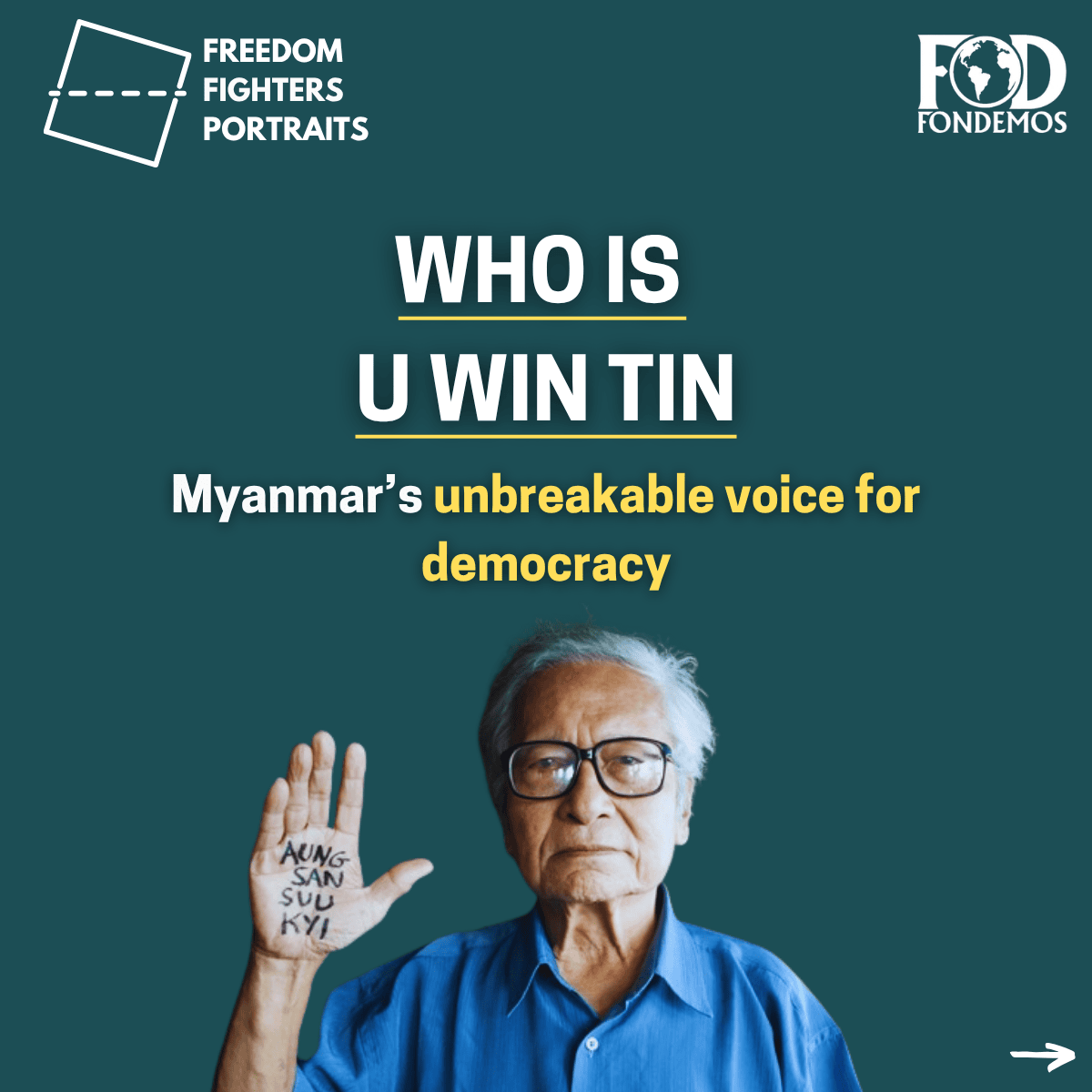
Born in 1930, U Win Tin became one of Myanmar's most respected editors and poets. In 1988, he participated in the founding of the National League for Democracy (NLD) alongside Aung San Suu Kyi. A year later, he was arrested. He would spend 19 years in prison, Myanmar's longest-serving political prisoner.
Imprisoned for the truth
His crime? Telling the truth. U Win Tin was arrested for sending a report on torture and prison conditions to a United Nations special rapporteur. Charged with "anti-government propaganda", he was sentenced to 21 years in prison. In 1996, his sentence was extended for the possession of a pen and paper.
Freedom was never for sale
He refused to be free on their terms. Multiple times, the junta offered U Win Tin early release, on the condition that he sign a document renouncing all political activity. Every time, he declined. For U Win Tin, a conditional freedom was no freedom at all. He chose prison over silence.
Released, still fighting
After his release in 2008, he never stopped. U Win Tin immediately returned to activism and to the NLD, mentored young activists, and demanded the release of all remaining political prisoners. Every single day, he wore his blue prison shirt: an unrelenting act of solidarity that inspired Blue Shirt Day. He wore it until his death on April 21st, 2014. Every year on that date, Blue Shirt Day keeps his memory alive.
« The dictators can only detain our bodies, not our souls. »
Support Fondemos
Every donation helps us continue supporting democracy's defenders.